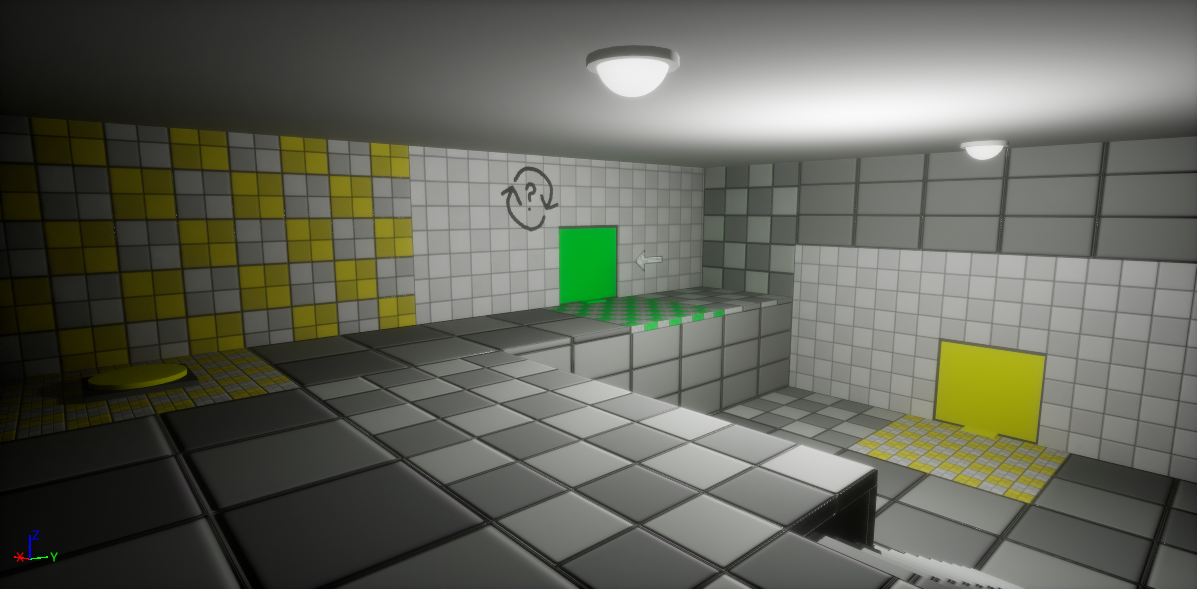
The Attributer
Game Summary
The Attributer is a first-person puzzle game that encourages creative thinking and experimentation. The player can manipulate an objects properties by extracting or giving attributes to them.
The main creative focus of the project was to create a gameplay system that was simple, but had a lot of depth. When designing the game, the ‘Attributing’ system was the foundation that everything else was built upon.
Pre-Production
The pre-production process was recorded on a Miro Board. It involved a pitching document, market research, design research, and design documentation.
There was particular focus on discovering a resonant theme during these early stages. I wanted to really ‘get’ or understand the core experience I wanted myself and players to experience when playing.
I also attended Develop: Brighton during this pre-production phase, there were some fantastic industry talks that gave me additional insight toward my design decisions!
Explore the Miro documentation!
Week-to-week development for this project was recorded by having weekly meetings with a supervisor, outlining what I did, what problems I faced, and what I plan to do next. The discussions were recorded in a forum that could be referred to at any time.
As a solo-developed project, critical feedback was invaluable towards producing realistic outcomes and outputs to work towards. With the original project plan being agile enough to change when blockers were met, but still retaining the identity of the experience.
A report was also developed alongside the project, it covers the entire development process. Detailing Ideation, production, engine work, and retrospective. Like any project there were big wins, as well as setbacks and I believe honest review is a fantastic path toward self improvement!
Development Workflow
Click the page below to open a new window containing the full project report!
Tools Used







Project Logistics


Team Size
Platform
Solo
PC

Duration
16 Weeks
Onboarding Principles to Players
Before players are able to use the Attributing System, first I wanted to reinforce the idea of ‘Colour creates context’.
This idea will be an important affordance for players to have when the action of Attributing is introduced to them.
Colour Creates Context
Level 1 - There is no colour present in this level, the cube opens the door when placed on the button.
Level 2 - The blue door only opens when the cube is placed on the blue button, players will begin to learn the colour matching design pattern.
Level 2 - To finish the level, the player will need to solve a simple puzzle involving multiple coloured doors. Through what they’ve learned, players should find this a fair challenge. It also serves to reinforce the importance of colour, which will be used throughout the game.
With the colour system properly onboarded, when given the ability to Attribute, players should naturally start swapping colours between objects.
The complexity and ideas behind the puzzles change throughout the gameplay loop, maintaining a steady difficulty curve;
This gives the player opportunities to have ‘a-ha!’ eureka moments often!
Learning to Attribute
Level 4 - When first learning how to attribute, one of the first challenges presented to the player is mixing colours! Puzzles can be solved through many different lines. You can solve this level by turning objects Green, Yellow, Blue, Red, or White. The basic concepts will be learned all the same!
Level 6 - Encourages the player to start directly swapping attributes. They need to quickly swap colours when under time pressure for success, it requires all primary and secondary colours to be mixed to show mastery over colour attributing. This level also introduces the sigil, which act as locks for doors.
Level 8 - By this point attributes outside of colours have been introduced, as their understanding of colour is complete. There is a need to introduce new and exciting concepts to always keep the player thinking, letting them explore the attributing system to the fullest!
Contributions & Takeaways
Contributions
Rapid prototyping in Unreal Engine to find what works with the idea, these prototypes informed design, pitching, planning, and feasibility.
Functional development process was followed from pre-production to the final game. Steps were not skipped, which led to an effective development cycle.
Research was conducted through reading relevant publications, analysing similar games, and attending events with industry professionals.
UE5 Blueprints were made to be modular and expansive, with the ability to easily add more to the core gameplay system. This led to multiplicative gameplay that had more depth each time a concept is introduced to the player.
Simplistic modular assets were developed to allow for the quick development of gameplay levels. With custom materials that could be modified to help guide or inform the player of intent.
Playtesting was conducted to gather feedback on the user experience, as a result additional feedback, level changes, and bugs were fixed to create a more enjoyable experience for players.
Takeaways
Taking the time to fully understand the experience you want to convey leads to developing strong foundations that are exciting and interesting to build from. This led to a very fulfilling development cycle, I would describe it as lighting in a bottle!
There is a delicate balance to onboarding players that is deterministic on an individuals skill level. Through testing, I made sure the difficulty curve was appropriate.
I wanted to make sure players who picked up quickly wouldn’t get bored, there shouldn’t be a feeling of being ‘in the tutorial’.
Whereas for players that needed more time to learn, they shouldn’t feel stuck, so there was opportunity for them to experiment and take in the unique gameplay mechanics.
Planning systems that are agile and modular is important. There are often scenarios in game development where a circumstance arises that requires a change in direction. With the proper planning in place to tackle a difficult circumstance, the change in plan should be as painless as possible.
A successful plan saves time & workload in the future.